Thursday, October 31, 2013

Yearly energy usage for a full time cruising boat - Viking Stars Energy report for the past 12 months.

It seems I get energetic in October.  Today I was updating the cost spreadsheet, plugging in readings from the Hour meters and started wondering - Hum.  How much energy did we use this last year?  Well, looking over Viking Stars blog I have asked this question a cople of times before:

For the 12 months ending Oct 2012: mvVikingStar.blogspot.com/../update-to-viking-stars-energy-use-per
12 months ending Jan of 2011:  mvVikingStar.blogspot.com/../viking-star-average-energy-usage


OK, so I have not been that consistent, nor fixed with October.  But who knows, maybe with two in a row a trend is starting!


How much energy do we use in a year?

Lets review.  Kristi and I use energy, just like most any person in the world does.  But as we live in a very small house and do not have a car, we use noticeably less energy than the average American.  We are full time cruisers and spend from the end of February to the beginning of November 'Out There'.  During those 8+ or so months we are fully dependent upon ourselves for energy production as well as, depending on how 'Far Out' we get, water production. During the core of the winter months we tend to come in and rent a transient slip, to get easy access to coffee shops and less-muddy trails.

Our source for Energy is primarily Diesel fuel, with a little Propane and Gasoline thrown in. And with that we move ourselves, heat our space and water, cook our food, generate our electricity, even make our drinking water as needed.  And for the last couple of years we have supplement our electrical needs with two Solar panels (mvVikingStar.blogspot.com/search/label/Solar)    When in port we try to use the shore power cord as much as possible because, truth be told, shore based energy is dramatically less expensive then on-board generation.

Over the past 12 months energy consumption on Viking Star has been:
  • 500 Gallons (320g for the Mains, 50 in the Gen/WM, and 120 for the Hurricane heater, maybe 10 more for the Dickenson)
  •  8 Gallons of Gasoline for the dinghy outboard motor
  • 15 Gallons of Propane for the stove and BBQ
  • 4,900KWh of Electricity while in port.


Running these all through conversions into a common energy measurement ( BTUs ) the above comes to 88 Million BTUs for the two of us.  A massive reduction from the prior years 116 MBTUs, continuing the downward trend from 140 MBTUs the year before that.  What changed?   Biggest change is how we heat during the Winter.  Up until last winter we had heated primarily with the Dickinson Diesel stove, a heater we still love for its warm dry heat.  But it is NOT the most efficient, only because it tends to be an all-or-nothing heater.  These days we rely on the Hurricane hydronic heater to warm the boat up in the morning, and let the electric space heaters take over and carry us throughout the day and into the evening.  That is perhaps the biggest change.  Solar helped some as well (See below)

As with prior years energy use of rental car / bus usage was not tracked; if we add say an extra 50 gallons of gas for the rental cars and buses we use, that adds another 6-7 MBUTs.   Lets 'Round up' our yearly energy usage to 95 MBUTs for the two of us, or a little under 50 MBTUs each in direct energy consumption.  


How does this stack up?

Going to be lazy here and just assume the average energy consumption per person has not changed that much from last year to this.  Hence am reusing last years 'chart'.  Converting the US Average of 98,418KWhs of energy consumption per person into BTUs we still get 336 MBTUs per-person.

336 MBTUs vs. 50 MBTUs.   Yes, living the Small Life on Viking Star we use less then 1/6th the amount of energy an average US citizen does.  


One Sixth...

In fact, we even use less energy than the average world-wide citizen does (at 72 MBTUs).

Living the Small Life on a Boat can be very very energy efficient, even if it is a 50 year old boat..


How much does it cost?

Doing a rough translation of the fuel used above (ala, using $4/gal for Diesel, etc.)  I come to a yearly cost of around $2,500.  Add in a couple hundred for Rental Car fuel, and we are at  a yearly energy cost of around $2,700  .

Which points out a big truth about Energy on boats:  We may use little, but what we use costs a LOT.  Hence the real strong focus on energy savings, LED lighting, efficent refridguration, Solar / Wind generation.

So, how does this compare to the direct energy costs you see in a year?  Electricity, Oil, Natural gas, Auto Gasoline, etc...


A note on the Solar Panels ROI

I added up the number of AHs produced over the past 12 months and it came to around 31,500Ahs of electricity produced.  This translates into over 260 hours of time we did NOT need to run the generator.  To date we have offset almost 45% of the cost of the solar installation by not running the generator, well on the way to achieving ROI in 3-4 years.


Energy.   As a cruising boat we know we use a lot more than others.  Between space heating, movement, computers, refrigerator and freezer, we are kind of an energy pig.   But I think looking at the lifestyle, it is clear we are comparatively but a wee-little one.


Cleaning and Pickling of Watermaker Membranes

The best way to keep a watermaker fresh and ready is to use it daily.  This keeps things from growing and / or dying in the Saltwater paths, membranes, and produce water paths.  Lacking usage it is recommended to 'flush out' the sea-water side of the membranes (and whole system for that matter) with fresh water.  This reduces the number of critters left from the sea water that, truth be told, start to die and start to stink things up.

I am told that with flushing we can go as many as 5-10 days up here in the cool water PNW, and maybe 2-3 days in warm water seas.  During summer we following this protocol by flushing the system before turning it off, and then either making water again, or flushing again, every 3 days.


Pickling

When it comes time to put the system away for the winter I 'pickle' the system. (side note, make sure to check here: mvVikingStar.blogspot.com/../addressing-major-flaw-in-water-maker.html to see a simple modification to allow for complete pickling of the system). Now a key question is: What to use to Pickle?  Recently I have seen a few folks talk about using the Pink antifreeze and perhaps this is a good idea.  Myself, I follow the DOW membrane technical manual and use a 1% (by weight) concentration of Sodium Metabisulphite.  Sodium Metabisulphite can be purchased locally at wine and beer making shops, or over the Internet.  I picked up a 2lb package on Ebay for something like $5. Once procured one needs to attach the needed pumps and hoses to allow for circulation of pickling solution.  Then:
  • Mix 1/2 cup of Sodium Metabisulphite in 4 gallons of water (make sure it is clean and chlorine free, use either freshly produced production water or the same water you would use to Flush per above).
  • Circulate this mixture for 30 minutes.
  • Cap system off and disconnect pickling pump/hoses.
  • Make sure to flush VERY WELL the pumps with fresh water; Sodium Metabisulphite can attach some components inside many pumps if left sitting.
  • Pickering will be good for 6-12 months.


Cleaning

Another step that is sometimes needed is cleaning.  This is indicated when production is reduced greatly (ala 15% or more) - typically caused as the result of fouling of some type in the membranes. Turns out there are two types of fouling: Mineral and/or Biological.  Mineral clogging is rather uncommon in our Seawater RO systems, it is more common in industrial waste water deployments.  However, Biological fouling can occur - mostly from letting the membranes sit inactive for too long without flushing or pickling.  Cleaning is much like Pickling except different chemicals are used, primarily Sodium Hydroxide (aka Lye).  Lye can again be purchased locally, look for hand-made soap supply shops, or again over the internet.  Cleaning instructions would be:
  • Mix 1 cup of Sodium Hydroxide (Lye) in 4 gallons of water (make sure it is clean and chlorine free, use the same water you would use to Flush per above).  If you have a way to heat the water to 70-80f it will work MUCH better.
  • DOW also suggests adding a very small amount of Na-DSS can help, but this is optional and I do not use it.
  • Circulate this mixture for 30 minutes.
  • Lit sit for 1 hour.
  • Flush very well with fresh water (Or run system, discarding all produced water, for 20-30 minutes).
  • Restore system and disconnect cleaning pump/hoses.
  • Again, make sure to clean VERY WELL the pumps with fresh water, Lye can be very damaging, treat it carefully.
Be VERY CAREFUL with Lye, it can cause nasty burns.


============================================================

I settled on the above directions after looking over perhaps 5-7 different watermaker 'user manuals' as well as Internet resources.  My confirmation, and final decision, was the DOW Filmtech technical manual as well as a DOW Tech Fact sheet on membrane cleaning.  Each RO maker often has their own special chemicals, which are largely (or actually are) the ones above.  IF you are using some other watermaker, do take care that some components can be sensitive to these chemicals, I found out about the Sodium Metabisulphite when it melted my pre-filters! (See: mvVikingStar.blogspot.com/../water-maker-pre-filters-failed.html ). 

But also make sure to research a little what water-maker manufactures recommend.  A friend sent me a copy of an Email from a water-maker manufacture chastising him in that absolutely under no conditions should Caustic Soda be used to clean their water-maker, you needed to purchase their chemicals.  A quick reading of their MSDS sheet for their cleaning power (which was rather costly) reveled it contained Sodium Hydroxide.  Guess that is OK as long as you do not call it "Caustic Soda "**.  So, YMMV..

Critical references:

Dow Fimtech Tec Manual: "FILMTEC™ Reverse Osmosis Membranes Technical Manual"
Dow Tech Fact Sheet: "Cleaning Procedures for DOW FILMTEC FT30 Elements"

In order to download the tech manual you will need to 'register' at the Dow site.  It costs nothing.
Note also that the above links might (likely will) change over time, so try copying he titles and googling for new links..

** and to get insight on 'Caustic Soda' :  "Sodium hydroxide, also known as caustic soda, or lye..."
https://en.wikipedia.org/wiki/Sodium_hydroxide


Monday, October 28, 2013

Stormy Stormy Night

During the lovely weather at our potluck, there was much talk of the anticipated WIND coming.  "Nor'easters" are faced with much trepidation here.

It WAS a blustery day yesterday, but the worst was yet to come, according to the forecast.  We were tired, and went to bed at 9PM last night, anticipating it could be a rough night.  We were woken at 10:30, and again at 2:30 when we decided we wanted to get up and see what it looked like.

It was not rocking that woke us.  It was more the noise.  The lid to the propane locker now has fasteners, but it still rattles in a strong wind.  The dinghy cover captures the occasional gust and lifts the dinghy, which then drops loudly back onto the coach roof above our bed.

The breakwater was doing its job!  But it has big black plastic cylinders on the outer side, to fend off boats and ships.  The waves were big enough to occasionally break OVER the breakwater, and bring a cylinder or two along for the ride.  Waves and cylinders DO crash.

As I write, the wind blows a steady 20-30 knots, and the peak gust reached 46.

But, its a beautiful morning!

Here comes the sun!

Debris kicked up, and you have to look close, but there is one of those cylinders next to the rail.

We have the door gaps taped closed, so all shots this morning are from inside.

PLENTY of salt spray on the windward side.

Sunday, October 27, 2013

Potluck!

We have a nice bunch of neighbors on the docks in Friday Harbor!

We arrived three weeks ago tomorrow, and one of the first things Jude and Richard said was that we all needed to get together and become better acquainted.  Earlier this week a more definite plan was made and news was spread by word of mouth.

The weather cooperated very well!  After weeks of fog, and a forecast of drizzle, the sun decided to make an appearance as well as a pretty big crowd!


Keith, Jenny and Justin arrive.  This is early.  The table AND the dock became much more crowded!

I love this picture!  We called Ted 'Happy Dog' until we learned his name, and he lives up to it.  Here he greets Heath as he arrives.  I also appreciate the big boat / little boat perspective.

Host Richard chats with Port Commissioner Bob, who arrived by boat!

Al calls Jude 'The Motivator'.  She played a big part in getting this event going.  

Friday, October 25, 2013

Something to Do

Yesterday it took until after 1 PM for Al to work up to a shower and getting dressed.  By that time I was pretty antsy, and I had plans!

I wanted to go to San Juan Cellars, replace the two wine glasses that dove off the shelf when we met a tug under the Second Narrows Bridge in Vancouver Harbor, and taste some wine!  Luckily, it didn't take much convincing at all to get Al to agree.

With new vintages, the prices I remembered were a little higher, but the wine was just as tasty as I recalled.  We stocked up on a few bottles and, since they are just the dock and a block away....I am sure we will be returning again soon.

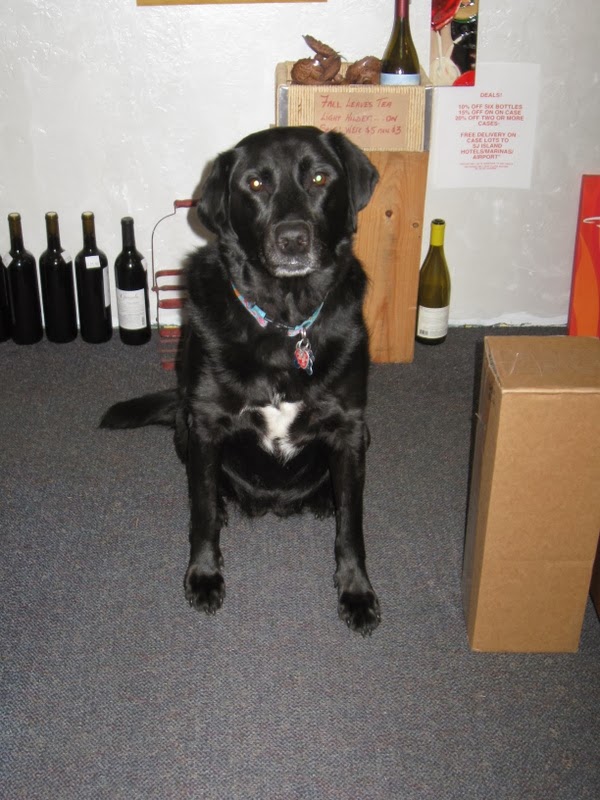
Grace's parents had just come back from vacation.  Her caregivers made sure she got lots of exercise while they were gone, so she had to be nudged from her nap to come say Hello.

It IS a yummy line-up!

Wednesday, October 23, 2013

Wiring Musing, Dual 30A shore power and Bonding concerns

Last of the Wiring Musings - here is one in response to a T&T question about how best to configure the neutral (white) wire when a boat has two independent 30A shore power cords.

==========================================================

Morning, and thank you - though be careful taking too much stock in the ramblings of yet another dunder-head...

In talking specifically about two 30A shore power cords and the issue of tying the white neutral wires together at the boat.  There are perhaps two large groups where 'issues' can occur:

1) Issues around how the power box is wired.
2) Issues around the two shore power cords.

There are likely other issues, but those two come to my mind readily.


1) Power Box wiring.

If, as you say, the two independent 30A sockets are in fact wired to the same network/feed (Say a massive 120v/200a wire set that is brought into the power box).  In this situation the two 30A sockets white wires are connected to the same neutral wire inside the power box.  As the power plugs are in parallel all voltages start at the same potential, and any imbalance that has to be 'corrected' by the boats bonding will be limited to differences between the two shore power cables/socks (See below).

If perhaps the power box is served by a 240v service, be is 3-phase or split-phase, we have the same situation: Again, the two 30A shore power cords will plug into a socket where the two white wires are connected together at the power box.  And again, our only concern is any imbalance in the two shore power cords/sockets.

But:  What If the power box is served by two independent feeds and the two sockets' white wires are NOT bonded at the shore power box?  In this case the common point would be back at the main power distribution point for the whole marina. For the life of me I cannot think why this would be done, but who knows what all is out there.   Now, in this case if we have connected the two shore power white wires together on our boat we not only need to bring into balance any differences in our shore power cords/sockets, but also the marina's wiring all the way back to the main power distribution point!   If on that return there are say other boat on the feed line we will be helping to balance any load differences from those boats as well.  Given enough boats, and enough marina wire back to their power distribution point, we could see a several amps of extra 'balance' current being sent through our boats white neutral wires.  And this is IN ADDITION to any current our boat is drawing.   IF we get 5A balance current, plus say 27A of our own consumption we have exceeded the 30A rating. (Side note:  a 30A shore power cord is not really designed for 30A continuous; they are de-rated to around 27A continuous.  This is perhaps one of the reasons we see so many burned shore power sockets, trying to pull 30A all the time - right at the breaker trip limit!  It is one reason I use a 25A shore-power inlet breaker on Viking Star.  The other being if I trip a breaker, I would rather it be the one inside MY boat, not the one outside on the power box.  In the rain . . . )

So, in THIS case we have a potential problem in that our boat is working to bring into balance a major portion of the marina.  And if our installation uses only a single pole breaker (e.g. does NOT have a breaker in the white wire) for the shore power cable this will cause problems very quickly.  And if we do have a dual-pole breaker we will get a bunch of nuisance trips due to the boat having to carry not only its load, but also any balance load the marina's wiring sends our way.


2) Issues around shore power cords.

OK, so the above is rather unlikely - finding a marina wired up in a very odd way that brings two independent feeds down for each 30A socket (as opposed to one large feed, or sharing a split-phase or 3-phase feed) are we out of the woods?  Not really.  Even if you are plugged into a power box that uses a 3-phase feed (rather common I think) and hence the two sockets neutral lines are wired to the same point in the power box we need to consider what CAN happen on our shore power cords.

In this example we have the two white wires bonded at each end; at the shore power box and our boat.  So, these two white wires (in the two shore power cables) are in parallel.  Ohms Law says and any current transferred will be allocated in direct inverse relationship to the TOTAL resistance of the two wires -AND- their sockets/plugs.   (Ohms Law is also what creates what I am calling 'balance current' in the example above, only in that case it is Ohms Law against the marina's wiring)  So, the resistance of the wire set, the shore box sockets, our boats sockets, the plugs on the shore power cord.  All come into play.

Ohms Law tells us that if the resistance of the two shore power cord/socket sets are exactly the same, current will be equally split between the two.   If we are pulling 15A over the black wire on one shore power cord, and 25A on the other, that gives us 40A being delivered to the boat.  Equally split we will send back 20A on each white wire.   Do note that what is sent back on each cord set is not the same as what is brought over!  And here is the 1st potential issue: if the shore power box has a GFI type device it will quickly trip!!! (That is their basic function: if what is sent out does not match what is brought back the GFI type devices figure current must be going somewhere - perhaps through you - so they trip)

Going further, let's say the two shore power cords are different ages and perhaps one has a little more resistance in it.  Or perhaps one of the socket/plugs has a little more corrosion on it then the other.  Combining to make a slight bit difference in total resistance between the two.  Now, instead of the return amps being equally balanced we start to see a shift in the balance.  Maybe it goes from 20A/20A to 19A/21A.   Or maybe the boater before you had dipped their cord in the sea before plugging into the shore box, and that one socket has a bit of corrosion on it.  So our balance becomes 14A/26A.   Or maybe it was you who did the dipping and we get 9A/31A.  Or .....    Bottom line is, the two will NEVER be the same.  And as a result one cord's white wire will always be carrying more current then the other.  Over time, more current = more heat = more stress, and perhaps we start to see that ONE shore power sock showing signs of heat stress, which will increase its resistance - sending current over to the other guy - who then starts getting burned.

Now we are back to the boats breaker question:   Once this imbalance crosses over the line do we a) start nuisance tripping the breakers, or I burn out the cords (aka, fire) if there is only a single pole breaker installed...


And you last question " Are not the two "independent neutral wires - one for each shore power cord" as independent as two neutrals from two normal branch circuits?"    AKA, how houses might be wired?   Yes they are, but in 'two normal branch circuits' one would not re-bond the two natural wires at the terminus of those two branch circuits.  All natural wires, be the individual circuits, or sub-panel / branch circuits are brought back to the main house panel and a common natural bonding bar inside that main panel.


So, bottom line:  There are a bunch of failure modes that can occur when tying the two white wires of independent 30A shore power feeds together on your boat.  Just not a good idea....


Hope this helps, and keep in mind this is about two INDEPENDENT 30A shore power feeds, using two separate cords and two separate socks sets and hence two separate white wires.  All the above does not apply when talking about a single shore power cord.  Be it a single 120v/30A feed, or a 240v/50A  shore power feed.  In these cases there is only one cord and only one white wire inside that cord - and no opportunity to 'rebond' anything.


Wiring Musing, 3-phase 240/208v power?

Continuing my 'reposting', here is kind of a composite post combining what I did in the Wooden Boat forum with an Email to the T&T mailing list - concerning the question around '240v' shore power measuring 208v. It is a common situation in many marinas, and boats which bring in 240v/50A shore power need to be aware of it, esp if they have motors which run off that 240v, e.g. an air conditioner compressor...

=======================================================================

Why do some marina's only have 208v on their '240v' plugs?  Industrial sites often have power distributed via 3-phase, while to houses it comes in split-phase. Hence, when you measure total voltage in a house, you get 220-240, but because of 'phasing', when you measure across two legs of a 3-phase source it come out to around 208v.

In the case of the split-phase feed system two hot 120v wires are supplied with one natural. But a key is that the two hot wires are 180-degrees out of phase with each other. This is accomplished by the power company using a center taped transformer. If one measures voltage from any one of the hot legs to neutral one gets 120v. If one measured voltage between the two hot legs one gets 240v (120 + 120 = 240).

With three-phase power things are a little different. There are 3 Hot wires in a 3-phase feed but now the legs are no longer 180 degrees out of phase. They are now are 120 degrees (360 / 2 = 180 while 360 / 3 = 120). Under this condition one needs to use vector math when calculating the voltage of two 120v feeds that are 120 degrees out of phase, and as a result the 240v now becomes 208v. It does not impact any of the 120v loads as they still see only one hot and the neutral (and do not depend on any phase relationship to derive their voltage), but any 240v loads are impacted. Most concerning are motors as they can overheat. The other impact one will see is any 240v heating elements (again, the dryer) will produce less heat.

Look at larger motors (single phase), and you will often see there is an options to purchase 220/240v or 208v,. It allows them to be installed in industrial sites where the power is supplied via a 3-phase drop. Water heaters, and even appliances like dryers can be special ordered for 208v. (I use to have a summer job installing such in high rise condos.). This is also why some boats have issues running their ACs in marinas, the ACs are set up for 220/240v which the generator will produce, while the marina has the three phase wiring and delivers only 208v. Tends to cause the ACs to run hot, and even burn them out early.

I think it is not totally correct to deliver two phases of a 3-phase to provide '240v' marine service, but it is a lot cheaper. To correct it, the marina would have to install transformers and deliver power as it is delivered to your house. So, their install cost is higher.

Big problem comes in that some marina's put in the extra cost, and have a proper 220/240 service, while others do not... And there seems to be no real 'regulation', so it is up to the individual marina to decide :-)

If all you do is pull 120v loads, none of this is an issue as with either type of service you will see 120v between one of the legs and neutral. But in your case, you are looking to pull 220/240v, and that is the problem here.

Solution is simple: Many  isolation transformer have the ability to be configured to 220/240v, or 208v as the input. Making sure the correct 'tap' is selected will fix this, but be aware that if you ever go to a different marine, you need to verify if they have 'proper' 220/240v service, or the 208v service, and then adjust your transformer accordingly.

If you do not have an isolation transformer, or do and it does not have does not have the ability to select between 208 and 220/240v an alternative (though not that clean) is to install a 24-36v 'boost' transformer in front of your shore power feed. These are readily available at electrical supply houses. Again, you will need to be careful to switch it in and out depending on the shore power configuration.