Showing posts with label Monk. Show all posts

Wednesday, September 11, 2013

Misery Bay

After a few days at the village of Sechelt, we moved on to explore Salmon Inlet.  Most of the way in, there is an anchorage called Misery Bay.  There has been another boat heading in that direction, way ahead of us, and Al worries that they will be anchored right where he wants to go.  Sure enough!  We round the point and there they are.

We set our anchor further in -- the chart shows a dotted line that we guess demarks the area for logging activities.  Then Al takes a closer look at the other boat and says, 'I wonder if that's a Monk.'  They got down their dinghy, loaded their dog, and head straight for us.  And their first question is, 'Is this a Monk?'

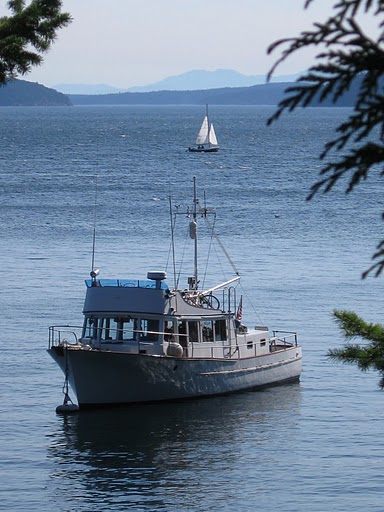
An impromptu gathering of Monks!  This is Jim and Alison, and their boat, Lily D in the background.

Ben is anxious to head to shore.  We invite them back for a visit.

Viking Star's little sister!

If I remember right, she was built in 1967, in Everett, Washington.  A Monk owned by Canadians, built in America.  Viking Star was built in 1961 at McQueen Boatworks in the Vancouver, British Columbia area. A Monk owned by Americans, built in Canada.  

The next morning they are on their way.  They turn left out of the anchorage, going to the head of the inlet.  We decided the night before that we would pull anchor when they left, and move to their spot.  But, since we are pulling anchor, we will head down to the head of the inlet for a look around too.  Lily D is back before we are done pulling anchor and reports there is some logging activity going on, and it gets quite shallow at the powerhouse.

A log truck approaches the slide...

...and drops its load to splash into the inlet.

The powerhouse

Just before 7 AM Monday morning, the crew boats begin to arrive in Misery Bay.

Three nearly identical boats are now tied to the dock, and all but one of the white pickups are gone from the yard.

Two hours later, we can hear something heavy approaching, and a loaded truck comes to the slide in OUR bay!


Another follows, and alternate -- white truck, yellow truck -- about every two hours.

Misery Bay is far from city lights, and we love to look at the stars.  They are ALL so bright that it is hard to identify constellations!

Saturday, June 1, 2013

Monk/McQueen

“The comfortable and beautiful boats designed by Ed Monk have been treasured for cruising, working and living aboard since the 1920s. Thousands of his fish-boats, sailboats, runabouts, tugs and power yachts have been built, mostly on the Pacific coast, and often by well-known builders such as McQueen, Philbrook, Grandy, Wakefield and Tollefson. Monk's books, his many popular articles in maritime magazines, and the reminiscences of those who worked with him highlight his practical philosophy of design. His boats were intended to handle the often rough and dangerous waters between California and Alaska, as well as the open ocean, in ease and safety.”

“Ed Monk was a modest, generous and talented man, much loved and esteemed by his clients, family and friends, and appreciated to this day by the owners of his sturdy and handsome boats.”

And so goes the fly-leaf in the book: “ED MONK and the Tradition of Classic Boats” by Bet Oliver.


George Edwin William Monk (a.k.a. Ed Monk, Sr.) (1-Jan-1894 to 21-Jan-1973) was a shipwright and naval architect in the Pacific Northwest of the United States. He was active from 1914 to 1973. He designed pleasure and commercial vessels, both power and sail.  Much of what we see in the way of small power boat designs (at least those that still retain a focus on Seaworthiness and Efficiency) can be attributed back to Mr. Monk, along with William Garden another very influential naval architect in the PNW during those days.
He was by all accounts one of the most modest men in the business; he also took great interest in the boats he designed and it was not unheard of small builders (or even home builds) ringing him up with questions and getting a complete answer, or even at times a surprise drop-by from Mr. Monk himself.  It was during this time that Ed Monk Sr. and George McQueen shared a long history together of producing a number of boats that became known as ‘Monk/McQueens’.  To this day it is possible to see a glimmer in someone's eye when we pass on that Viking Star is a Monk/McQueen, but it is also true that this legacy is fading.


We have owned Viking Star for almost 13 years now, and in those past 13 years I have watched as several ‘remembrances’ of Ed Monk Sr. fade into time.   A Boater's Club http://www.edmonkwoodenboatclub.org/ has been all but inactive the past 5 years.  Occasionally there will be a flurry of ‘We need to get something going’ on the Emailing list (which is still in place), but that soon dies down.  McQueen Boatworks, like many small yards, had been struggling for years – and it too seemed to be fading.  Last week while in the greater Vancouver area I confirmed this to be true – the property where McQueen Boatworks was located is up for lease:

But there was one glowing tribute to the combination of Ed Monk Sr. and George McQueen in Vancouver.  Highly visible, and right on the waterfront:  Monk’s - McQueen Restaurant.   With its big red Monk’s sign lighting up the False Creek Harbor night.   Though I am sure very few of the patrons understood the origin of the name, still I was looking forward to eating at the deck of Monk’s, overlooking Viking Star.   Sadly, that too is no longer.   Monk’s - McQueen restaurant closed last New Year, and is scheduled to be replaced with an Irish Pub.  Now, not that I have anything against a good Irish Pub (in fact, I kind of like them), but it is noticed that remembrances of Ed Monk, Sr.’s legacy are fading. . .

A Monk/McQueen anchored in front of Monk's - McQueen


Wednesday, February 18, 2009

Yes Virginia, I am a POWER boat..

Caution: The following is long, has opinions and I even brought out the Soap Box. . . . .

So what is with this Power Boat thing? I thought people who cruised did it in Sail boats, or if they wanted to really be hip maybe a Cat... How can you be thinking of doing something like this in a Power Boat?

Well. First off. I love sail boats. More correctly, I love sailing. Before Viking Star I had a sail boat, and would get Sails Up 2-3 times a week during the summer. (err, Dating at the time might have had something to do with that :-) And I can tell ya, there is TRULY little better then burying the rail while close hauled. God I miss sailing...

So, how did I end up with a POWER boat? Well, it was one night while surfing yachtworld.com, where I would often search for any single engine diesel boat under $40,000, sorted by size. (Have I mentioned that I am rather frugal? Some would say borderline cheap. Others, well, maybe others might not use the word borderline...) Anyway, I had been doing this for many years; just dreaming. And I ran across Viking Star. What attracted me to her? The designer. Ed Monk Sr. has passed on now, but his influence is still felt. You see, not ALL power boats are the same. (Getting out my Soap Box now) - It is true that MOST power boats have been shaped largely by marketing. Not that this is totally a bad thing (I am a Marketeer by trade, what else could I say), but it does tend to move design points away from less than pure goals. In the case of Power Boats, we have gotten: Beamy, stacked, high initial stability semi-planing hulls with an excess of power. Why? Well, these boats offer:
  • Lots of interior volume. We see side decks getting smaller and smaller, even disappearing on one or both sides.
  • No rolling! Wives are more often than not dragged aboard. Lets face it. And aside from being typically rather reluctant in the first place, once a boat starts to "Tip Over", well, forget it.
  • Speed. Semi Displacement hulls offer the ability to break Hull Speed - providing you pour enough power (and fuel) into them. Over the years you have seen singles go to twins, and twins go to 400 - 500 - 600HP.
Now again, this is not all bad. Room is often a good thing. A stable platform does make folks more comfortable in calm seas. And given the fast pace of our current society, the ability to travel a good distance for the weekend offers benefits. Market driven boats serve a purpose, if they did not they would not exist.

But, the above is rather counter intuitive for a cruiser.
  • Lots of interior volume: Small or no side decks, pitty the deck hand, but more so think of safety.
  • Lots of interior volume: Stacked decks. Great for room, not so great for sea kindness.
  • No Rolling! Yup, hulls with high initial stability are great when at dock, or out for a day cruise. But getting into even 4' chop will bring new meaning to Hating Life.
  • Speed. Well, pick one: Speed or economy. No secret here--heck, just driving 65 instead of 75 tells us that.
Putting away the soap box, what does this have to do with you trying to do this in a POWER BOAT! Doesn't this just prove the fallacy of it? Well, maybe. See, remember I said Viking Star was a bit different. She does not have a design point driven by marketing, but instead one driven by sea ability and efficiency.
  • Modest interior volume: Viking Star has wide side decks, with bullworks and stout rails all around. We feel (and largely are) safe onboard underway and during docking / anchoring maneuvers.
  • Modest interior volume: Viking Star is not double stacked. Her Center of Gravity is rather low. 4000 lbs or so of concrete and lead ballast helps this as well.
  • No Rolling. Well, here you all got me. We roll more then Santa Claus's belly during a jolly laugh. See, Viking Star has a near full displacement hull, and no hard chines. Makes for what is called a tender hull. Rolls a whole bunch, but once you remember to put things away, is very forgiving in seas. And much less fatiguing to the crew then the snappy motion of a semi-planing hull in heavy water..
  • Speed. Again, you got me. The rule of Viking Star is you had better enjoy where you are, cause we ain't getting away from here fast.
It is largely about the hull. Viking Star is based on a displacement hull, with lots of ballast. She needs modest power to move through the water, and can take seas well. She came out of a design oriented more towards commercial fishing craft than market-driven goals. And she is rather rare in that case compared to most power boats. In fact, with the exception of some notable boat designs who also follow these design goals (Willard, Krogen, Nordhavn to name a few), Viking Star is very very rare.

And that is why I purchased her.

See, we have good interior volume, she is very capable/safe, and has a hull that is rather efficient and thrifty. She burns 1.5 GPH making almost 7 Kts (6.8-6.9 to be more accurate). This compares to about 4GPH for a very popular power boat which shares a lot of the above the water line looks with Viking Star, as well as length and displacement, but not the hull. However, Viking Star can break into double-digit speed ONLY running down river with a good spring run-off. Depending on the motors in the more popular boat, they can easily make 15-18 kts, and some can even break into the mid 20's.

OK, so she is special, but she is still a POWER BOAT. Cruisers need Sails, are Sail boats! Everyone knows that.

Well, maybe. I'll pick this up in a future Blog, I am starting to get the Eye from Kristi on how long this one is getting. . .