Tuesday, October 16, 2012
Lopez
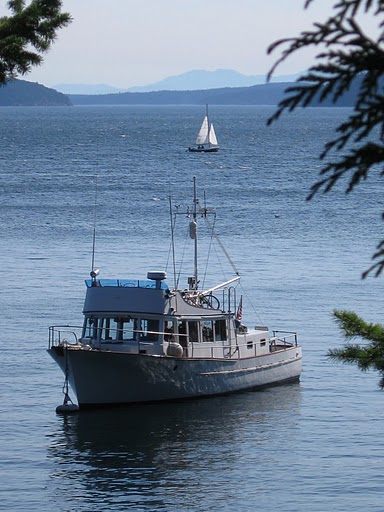
Well, we entered the San Juan Islands and made a bee-line for Blind Bay on Shaw Island, to tuck into a corner and hope predicted winds would just blow over us. It worked! We were snug and comfortable.
We worked on re-learning how to do nothing. For Al, that was reviewing playing with the SSB and researching out energy usage over the past year, especially on his mind since we filled our tanks in Oak Harbor.
For me, doing 'nothing' included scrubbing the shower, doing a thorough vacuuming, and cleaning the iron stovetop with steel wool, and then oiling it. Oh, and I read two and a half books.
Today, we moved to Fisherman Bay on Lopez Island. The winds were a bit more than predicted, and the waves were about three feet tall. That's nothing when we are heading straight into them, but when you have to turn broadside to enter a very narrow passage, it can get a bit tricky.
The broom and mop fell over. 'The Girls' were frightened from their perch. Several books fell from my shelf. And Lindsay's picture jumped from it's place. Felix was tucked into the curve of the settee, so he was quite comfortable.
We took a spot in the marina, hooked up the power cord, and walked up to the office to take care of business. We stepped over to the bar and had a burger for me, fish and chips for Al, a couple of drinks, and observed a large boat break loose from it's anchorage and resort staff rushing down the docks and out in two boats to capture it. We at first were afraid that two people we saw going out in a dinghy had somehow fallen in the water, but a local was present who recognized the boat and said that wasn't the case.
We decided to walk in to the village and had fun recalling our visit here in August 2011. Many places were closed today (the fudge shop, the wine tasting room, the bakery) but we had coffee at Isabel's, and spent some time at the library.
We returned to the boat just as the sun set. Fisherman Bay is NOT sheltered from the southwest winds. The waves occasionally break onto the dock. Our wind speed gauge says we got to 40 knots!
The docks are wet -- walk carefully. And as I write, it is dark. There is not much lighting on the docks, so we are IN for the night.
We REALLY like Lopez Village, but our visit here now reinforces that our decision to winter at Friday Harbor is the right one.
Sunday, October 14, 2012
"This is KF7HMU - Maritime Mobile. . . . ."
Being at anchor and on the boat for three days while this fall's 1st storm passes through gave me some time to do things. One of the long-time projects was to complete our SSB installation Mostly this was mounting and connecting the antenna tuner, and this afternoon I completed that.
I also made my 1st radio contact! The 14300 net was being 'kept warm' with an informal net host. When he asked for any traffic that wished to check in, I did so! Was a little rough as he faded in and out, him being in North Dakota and all, but when a station from Atlanta stepped into relay things went well!
This is my 1st time using an MF/HF radio, and am still learning. But did make contact! Still need to connect the Pactor and other refinements ala adding a ton of Ferrite Cores. And I need to dig-out the SWR meter to see how the antenna / ground system is working. Though we have not really needed the SSB to date, I expect when we begin moving north it will become more and more useful Not only for HAM talks, but receiving weather Faxes, and even short Emails to keep in touch.
There is more to do. Finishing the installation (Pactor), debugging and optimizing. Plus a whole lot of learning around frequencies, usages, and hops.. Both HAM and proper marine SSB chanels. But for today I got on the air and got a "5 and 7" from ND! So, that is not too bad. I guess.
Saturday, October 13, 2012
Update to Viking Star's energy use per year
A year and three quarters ago I was bored. So bored that I sat down to look at our energy usage vs. the 'average' American: http://mvvikingstar.blogspot.com/2011/01/viking-star-average-energy-usage.html
Guess what. I am a bit bored again - after a summer of running around we have just not gotten into the swing of 'Not Doing Things' lifestyle. So today, among others, I sat down to look again at our 'household' energy use for the past 12 months. In total we consumed (well, purchased):
As before this is only direct energy consumption. Fuel used for Mass Transit, as well as energy used to grow and ship that potato is not reflected. We did use around an extra 6 MBTUs of gasoline in the rental cars. So, that puts us at 116 Million BTUs. for the past 12 months.
This is a noticeable increase over the 86 MBTUs used in 2010, but we should note this time we are underway much more. Plus we spend a much larger time away from the docks than before - in 2012 we used 200+ gallons more of diesel, and less than 1/8th the electricity. (More moving, less dock sitting..)
So, how does this new '116 MBTUs' compare to the national average? Still well under the household average of 140 MBTUs in my prior post, and today I found this new cool chart.
Using the last line (Yearly KWh usage) and converting it into BTUs we get a US Consumption of 336 MBTUs per person. Or 672M BTUs for 2 people. So, this means we are using perhaps a 5th of a typical US residen? After all, we live in a very small 'house'. If we add in say 50 gallons of gas for our auto trips and bus, that only adds another 6 MBTUs,
Could we do better?
Installing the Solar Panels will help some, though perhaps the larger benefit is not having to listen to the generator during the summer.
We already Go Slow with the last fuel fill showing us burning around 1.4GPH. With 300 hours on the main over the last year, perhaps we could try to 'stay put' more in the future. (Lets see, 300 hours in a car at say an average of 35 MPH throughout the year comes to 10,000 miles. OK, so our 'car' is a bit larger, heck some might even call it a Boat!)
Last winter's records show a bit over 200 gallons of diesel went to heating Viking Star. Given the very small space involved that is a lot and is reflected in both the All or None approach of the Dickinson stove, as well as the poor insulation of Viking Star herself This coming winter we will try different approaches to heating (the Hurricane taking some of the load, as well as additional ways to utilize electricity when it is available). Not too sure about the insulation, as to be honest - air exchanges in such a small space are important. But who knows maybe next year. And for this year we got a fresh roll of Blue Masking tape!
Guess what. I am a bit bored again - after a summer of running around we have just not gotten into the swing of 'Not Doing Things' lifestyle. So today, among others, I sat down to look again at our 'household' energy use for the past 12 months. In total we consumed (well, purchased):
- 775 gallons of Diesel (107.3 MBTUs)
- 10 gallons of Gasoline (1.2 MBTUs)
- 15 gallons of Propane (1.4 MBTUs)
- 88 KWH of Electricity (0.3 MBTUs)
This is a noticeable increase over the 86 MBTUs used in 2010, but we should note this time we are underway much more. Plus we spend a much larger time away from the docks than before - in 2012 we used 200+ gallons more of diesel, and less than 1/8th the electricity. (More moving, less dock sitting..)
So, how does this new '116 MBTUs' compare to the national average? Still well under the household average of 140 MBTUs in my prior post, and today I found this new cool chart.
Using the last line (Yearly KWh usage) and converting it into BTUs we get a US Consumption of 336 MBTUs per person. Or 672M BTUs for 2 people. So, this means we are using perhaps a 5th of a typical US residen? After all, we live in a very small 'house'. If we add in say 50 gallons of gas for our auto trips and bus, that only adds another 6 MBTUs,
Could we do better?
Installing the Solar Panels will help some, though perhaps the larger benefit is not having to listen to the generator during the summer.
We already Go Slow with the last fuel fill showing us burning around 1.4GPH. With 300 hours on the main over the last year, perhaps we could try to 'stay put' more in the future. (Lets see, 300 hours in a car at say an average of 35 MPH throughout the year comes to 10,000 miles. OK, so our 'car' is a bit larger, heck some might even call it a Boat!)
Last winter's records show a bit over 200 gallons of diesel went to heating Viking Star. Given the very small space involved that is a lot and is reflected in both the All or None approach of the Dickinson stove, as well as the poor insulation of Viking Star herself This coming winter we will try different approaches to heating (the Hurricane taking some of the load, as well as additional ways to utilize electricity when it is available). Not too sure about the insulation, as to be honest - air exchanges in such a small space are important. But who knows maybe next year. And for this year we got a fresh roll of Blue Masking tape!
Wednesday, October 10, 2012
Viking Star Refueling Kit
It is that time of year again, time to fill up the tanks! Carrying 500 gallons of fuel gives us a lot of flexibility in when to fuel and typically we look for a dip in prices throughout the year. This year though we had to miss the biggest dip as I wanted the tanks drawn down during the Haul Out. So we pushed it off a bit, and in the end were able to get for perhaps $0.40 off of the summer peak price. Even so, when taking on almost 400 gallons of fuel - some preparation and supplies are needed.
Spud wrench to pull the fuel caps, oil absorb pads to contain the spittle while fueling. Kristi monitors the fuel tank guages, we typically fill up to 90% of capacity (though this year we topped them off in preparation for the winter heating season). A good Scotch, and appropriate glass for after, Log Book to record it all, and then The Bill...
We took on 386.566 gallons this time (really, they measure this stuff to the 1,000th of a gallon now?). An amount that surely will impact our Cost to Cruise. However, this will cover us for the winter and into Spring. In a future post I will do a breakdown of fuel usage Motoring, Electricity, Heating and update our comparison to the national average for Energy Consumption. As well as recalculate the GPH burn rate for the main motor (The last figure of 0.88GPH seems great, but is to be honest a bit unbelievable)
And finally adding nearly 4,000lbs of weight to the boat always help her settle in and give a better ride during less than 'glossy' water. Something Kristi, Felix and even I always enjoy and just in time for this weekend's storm fronts that will FINALLY make it into the area. Goodbye Summer.
Monday, October 8, 2012
Highlights of the Past Few Days
1. A Seattle sunrise
2. Meeting Dick and Anja Bielenberg in Eagle Harbor, Bainbridge Island. We were their guests at their MTOA Friday night event.
3. Dinner with daughter Lindsay on Saturday night. Since we chose the Cheesecake Factory, of course we had to have cheesecake!
4. Seeing this ocean floor map in a shop window on the way back to the ferry dock.
5. Going through Agate Pass, and crossing another passage off our list.
6. SEEING ORCAS! I wish, again, that I had a better camera. This is the best photo, and you can JUST tell that is an orca fin.....
7. It was a gorgeous day on the Puget Sound. AAaaahhhhh, glossy water! Life is but a dream!
8. And another beautiful sunset from Jetty Island at Everett.
2. Meeting Dick and Anja Bielenberg in Eagle Harbor, Bainbridge Island. We were their guests at their MTOA Friday night event.
3. Dinner with daughter Lindsay on Saturday night. Since we chose the Cheesecake Factory, of course we had to have cheesecake!
4. Seeing this ocean floor map in a shop window on the way back to the ferry dock.
| See that little fish shaped hook to the SE of Sucia Island? That's what we hooked with our anchor last May. see http://mvvikingstar.blogspot.com/2012/05/assessing-damage.html |
6. SEEING ORCAS! I wish, again, that I had a better camera. This is the best photo, and you can JUST tell that is an orca fin.....
7. It was a gorgeous day on the Puget Sound. AAaaahhhhh, glossy water! Life is but a dream!
| The same sailboat, and another, now looking westward toward the Olympics |
8. And another beautiful sunset from Jetty Island at Everett.
Thursday, October 4, 2012
Felix
Well, I've begun my mantra again.
I don't like bumpy water.
We left Quartermaster Harbor on Tuesday and went to Blake Island, despite a marine forecast calling for 15-20 knot winds and 3-4 foot waves. I would perhaps have liked to stay another night, since they were supposed to diminish later Wednesday, but it turns out that was the best time to go.
We got to CRUNCH through the leaves on the trail on Blake Island! Al noted how that is quite a rare occurrence here in the Pacific Northwest.
This morning, two boats left the harbor at Blake early, because they had heard the winds were going to build again throughout the day. Yes, they are STILL blowing --
It's only just over an hour from Blake Island to Eagle Harbor on Bainbridge Island. The waves are bigger than they were off the east side of Vashon the other day, when I said that it kinda wasn't very fun. Those were only 2-4 feet with scattered whitecaps. These are a solid 4 feet, with MANY whitecaps, and a few sneaky 5-footers. Add in some ferry wake, and it's quite a ride for a girl who doesn't like bumpy water and has been spoiled on the South Sound all summer.
But, Felix remained calm.
I warned Al that if Felix got jumpy, I was likely to also.
Al: Maybe I should put some more beans in his butt. (Felix has a mini beanbag butt to help him maintain his seat.)
Me: That's just it!!! He has beans! I don't!
Al: I could always add a seatbelt for you.
Wednesday, October 3, 2012
Cost to Cruise – September 2012
September came, and it has gone. During that time we hauled Viking Star for maintenance, and made yet another unplanned trip down to Portland. Looking at the categories maintenance was obviously up, what with the haul out and having access in Portland to my favorite marine surplus stores!
Haul out is also reflected in Transportation, as we rented a car for the time. And another car rental for a trip back to Portland.
Personal – well, I guess I can blame that on the haul-out as well. This is what happens when one hauls the boat out on YOUR WIFE’S BIRTHDAY! I am applying bottom paint while Kristi has the car, credit cards, and access to malls.
As we head back to Friday harbor for the winter we will expect a fuel bill next month which will give me another data point to calculate main engine fuel usage. (last round put us a 0.88GPH).
As expected, solar output is down due to the yearly migration of the Sun south for the winter. Even so, average daily output of 115Ah was above predicted modeling! And we did have to use the generator this month – for about 1/3 of the laundry runs - to cover the drying cycle.
| September 2012 |
Haul out is also reflected in Transportation, as we rented a car for the time. And another car rental for a trip back to Portland.
Personal – well, I guess I can blame that on the haul-out as well. This is what happens when one hauls the boat out on YOUR WIFE’S BIRTHDAY! I am applying bottom paint while Kristi has the car, credit cards, and access to malls.
As we head back to Friday harbor for the winter we will expect a fuel bill next month which will give me another data point to calculate main engine fuel usage. (last round put us a 0.88GPH).
As expected, solar output is down due to the yearly migration of the Sun south for the winter. Even so, average daily output of 115Ah was above predicted modeling! And we did have to use the generator this month – for about 1/3 of the laundry runs - to cover the drying cycle.
Subscribe to:
Posts (Atom)